A complete guide
Your birth chart is not a horoscope. It is a precise astronomical document — a snapshot of the sky at the moment you arrived. Learning to read it is learning to read yourself. When you are ready to turn positions into language that feels alive and precise, use our placement library — start with the planets in houses, planets in signs, and natal aspects hubs, then open any specific placement while you draft your reading.
The four layers
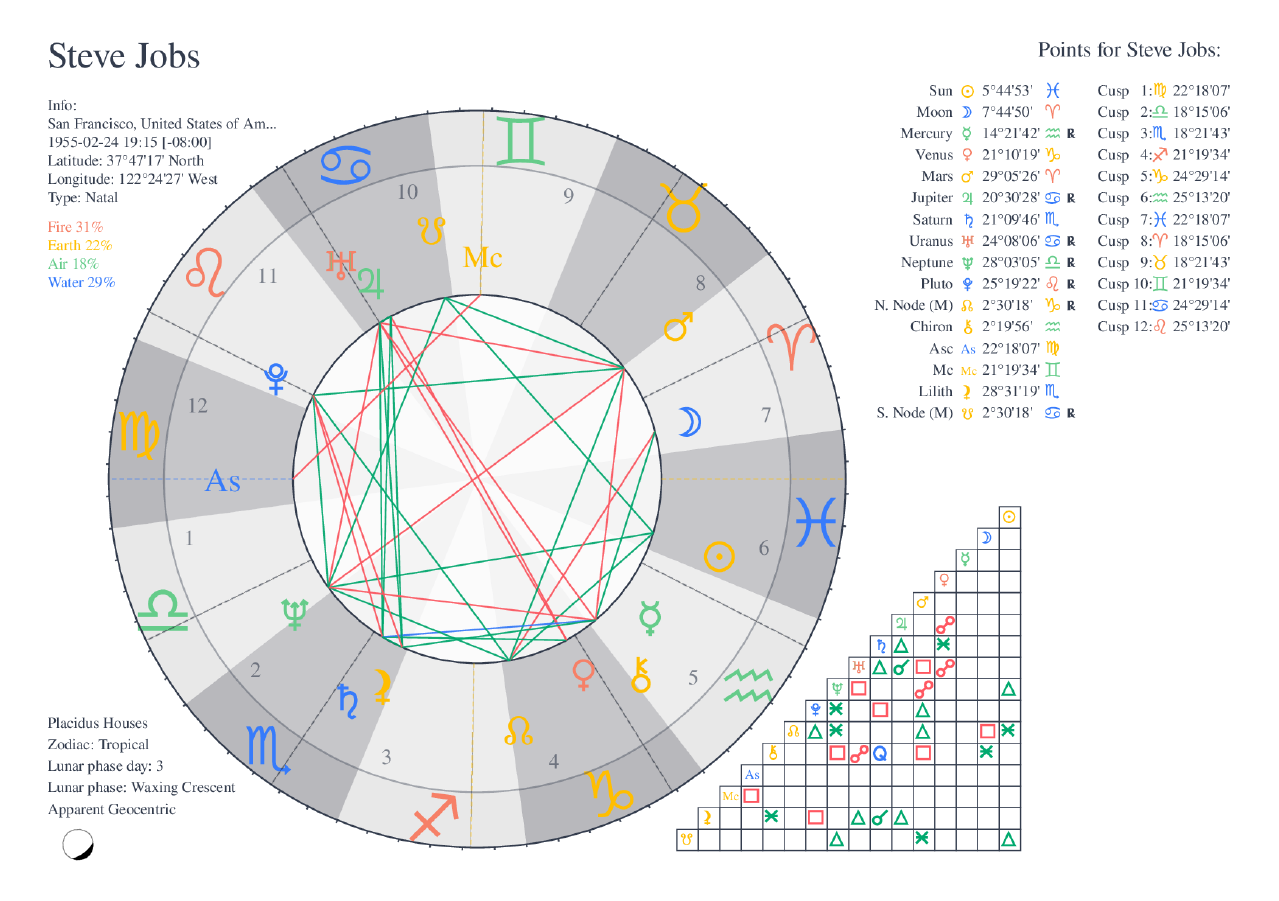
Every natal chart contains four fundamental layers. Understanding each one — and how they interact — is the foundation of all serious astrological interpretation. We use Steve Jobs' chart throughout this guide as a real-world example. As you go, use the Placement Meaning Guide for placement-by-placement notes while you draft your own readings.
Steve Jobs — February 24, 1955, 19:15, San Francisco. Virgo rising, Pisces Sun, Aries Moon.
Where to start
Before anything else, find your Sun, Moon, and Ascendant. These three placements form the unbreakable core of every chart interpretation — the lens through which every other placement is understood.
Where life happens
The houses are the stage. Each house corresponds to a domain of lived experience. When a planet occupies a house, it brings its energy to that area of life. The sign on the cusp of each house describes the style in which you approach that domain.
Unlike the signs — which are the same for everyone born in a given month — the houses are unique to your specific birth time and location. They rotate by one degree every four minutes. Two people born hours apart in the same city can have dramatically different house placements.
This is why a serious natal report requires your exact birth time. Without it, the house system collapses into a generic profile. With it, the chart becomes a precision document of your specific life architecture.
The Jobs illustration
"His Sun in the 6th house of work and craft, Mars in the 8th house of transformation and power, Moon in the 7th house of partnership — it tells the story precisely. Visionary energy channelled through obsessive work, driven by a need to transform industries, expressed explosively in one-on-one dynamics. That's the chart. That's the man."
The inner geometry
The coloured lines inside the chart wheel are aspects — angular relationships between planets. They reveal the inner dialogues of your psyche: where energies flow easily, where they create friction, and where they amplify each other into something larger.
Natural flow and ease between two planetary energies. Talents that feel effortless — sometimes so effortless they go undeveloped.
HarmoniousOpportunity and cooperation. Less automatic than a trine — requires some effort to activate, but rewards when engaged.
HarmoniousFriction and tension between two drives. The source of greatest frustration — and greatest achievement. Squares produce.
DynamicTwo polarised energies pulling in opposite directions. Often experienced through other people — we project what we won't integrate.
DynamicFusion of two energies into one intensified force. Can be brilliant or overwhelming — depends entirely on which planets are involved.
Intensifying
The Natal Blueprint difference
Most chart reports give you a keyword dump: "You are creative, ambitious, sensitive." That's not interpretation — that's a horoscope. A real natal synthesis integrates every layer into a coherent portrait of who you are and what you're here to do.
The living chart
A natal chart is not static. It is a living document activated by time. Several techniques reveal when your natal patterns are most strongly triggered — and what kind of energy each period carries.
The current positions of planets as they move through the sky and make contact with your natal chart. Transits are the most immediate timing technique — the weather of your life, not the climate.
The chart cast for the exact moment the Sun returns to its natal position each year — your personal new year. The solar return chart reveals the dominant themes, opportunities, and challenges of the coming twelve months.
Secondary progressions move the natal chart forward at a rate of one day per year of life. They describe the slow internal evolution of the psyche — how your core self matures and shifts over time.
An ancient Hellenistic technique that activates one house per year of life in sequence. Each year has a "lord" — the planet ruling that year's activated house — which becomes the dominant theme of the twelve months ahead.
Your chart awaits
You have the framework. The Natal Blueprint reports do the synthesis — integrating every layer into a precise, readable portrait of who you are, what you're working with, and when your key patterns activate.
Bring the same rigour to every line in the wheel: the Placement Meaning Guide lets you look up any planet-sign, planet-house, or aspect pairing in seconds — polished reference copy you can lean on while you practise, teach, or deepen your own chart without losing the thread.