
Content note: this article discusses suicide and accidental death.
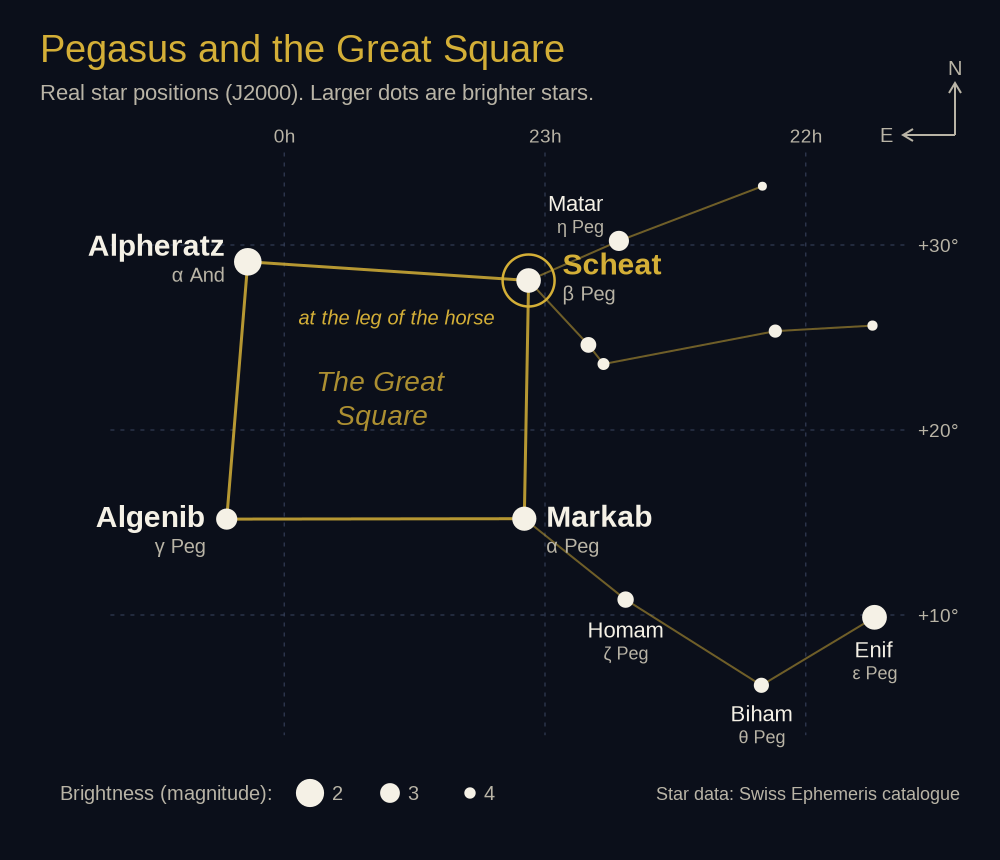
Scheat sits at the leg of Pegasus, at about twenty-nine degrees Pisces in the tropical zodiac. Right now it’s at roughly 29°45′ Pisces, creeping forward about a degree every 72 years, and it won’t cross into Aries until the mid-2040s. In the fixed star tradition it’s one of the most double-edged placements there is: extraordinary creative vision paired with a reputation for self-destruction, addiction and early death. Not a gentle influence. The old texts are blunt about it.
What the old texts say about Scheat
Vivian Robson’s Fixed Stars and Constellations in Astrology (1923) gives Scheat a single grim line: it “causes extreme misfortune, murder, suicide, and drowning.” He’s not alone. Richard Hinckley Allen’s Star Names (1889) records that the old astrologers saw this star as a sign of “danger to mankind” from water. The Arabs counted Scheat and its neighbour Markab as the 24th lunar mansion, the Fore-Spout of the water bucket. The advice for the Moon passing through it was plain: plant, sow, marry, but don’t go to sea.
That’s only half the picture, though, and the other half is why the star matters to anyone who makes things. Elsbeth Ebertin and Georg Hoffmann, in Fixed Stars and Their Interpretation, wrote that Scheat can sharpen the mind’s creativity in people ready to take it. Bernadette Brady, in Brady’s Book of Fixed Stars, goes further. She reads Scheat through the Great Square of Pegasus, the four-star box that marks the horse’s body, and links it to the urge to live as a thinker, someone who works things out with their own intellect. Her Scheat person questions the accepted story and builds their own. Old texts talk about drowning. Newer ones talk about original minds. Both are describing the same star.
Kurt Cobain: Scheat on Saturn
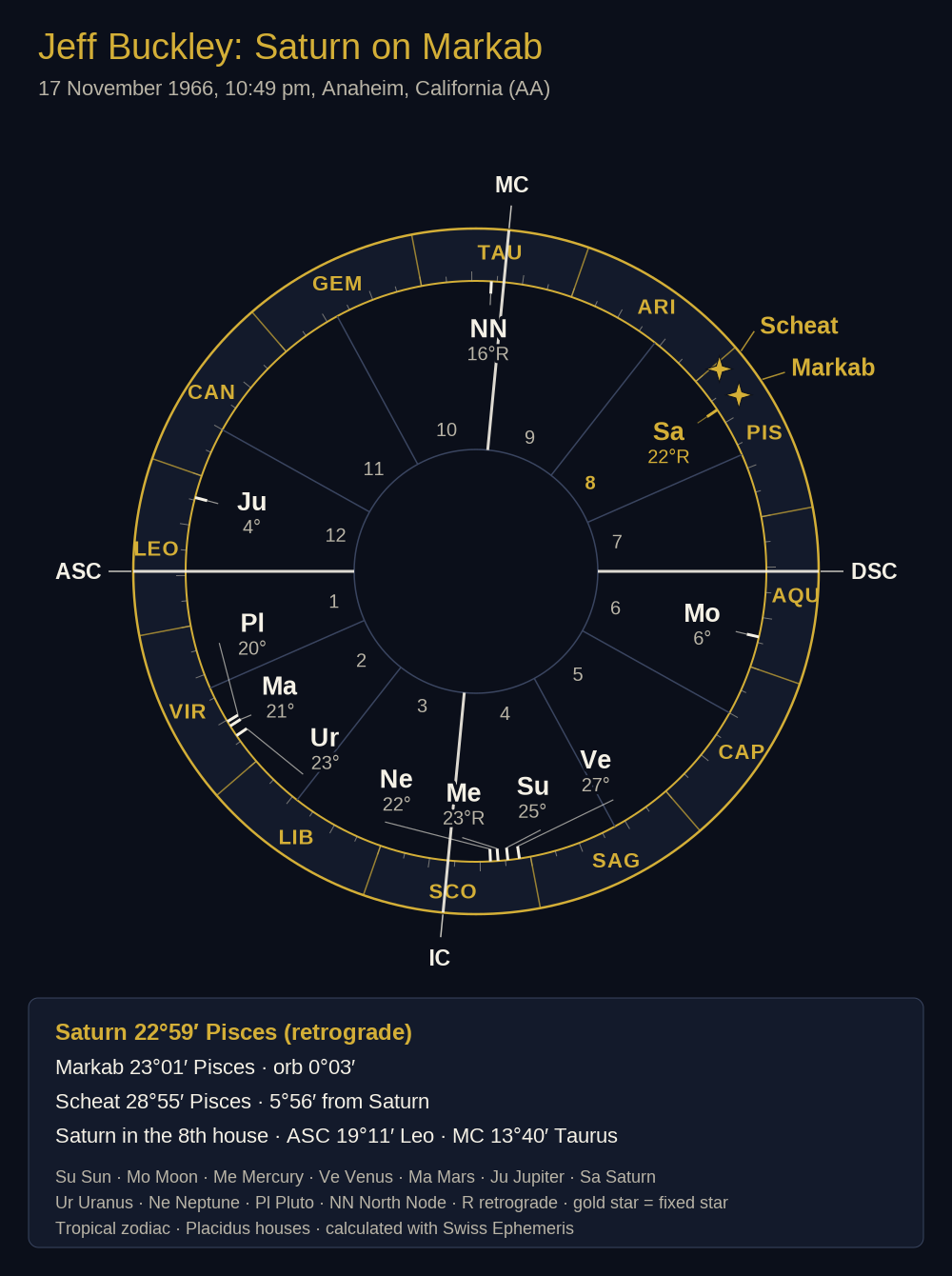
Kurt Cobain is the case everyone knows. He was born on 20 February 1967 at 7:38 pm in Aberdeen, Washington. That time comes from his birth certificate, which gives it the top AA reliability rating. When I calculated his chart with Swiss Ephemeris, Saturn came out at 28°44′ Pisces, about eleven minutes of arc from Scheat. That’s as tight as fixed star contacts get. With Virgo rising, both sit in his seventh house, a few degrees past the Descendant, which is one of the chart’s four angles. Venus, at 26°33′ Pisces, is a little over two degrees away, inside the orb many astrologers allow for a bright star.
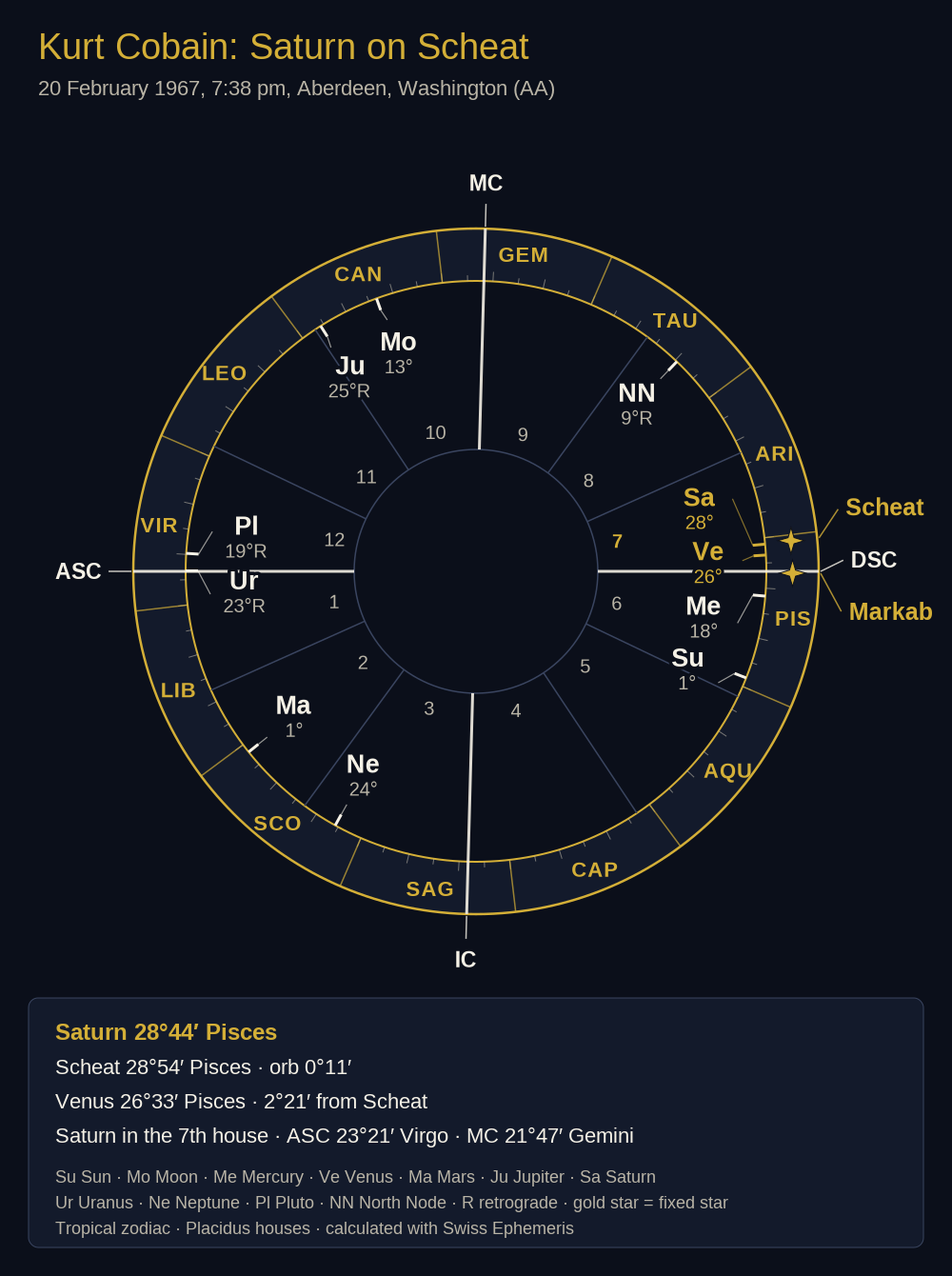
Saturn on Scheat is a heavy combination. Saturn is the planet of weight, limits and endurance. Robson’s notes for Scheat with Saturn are as bleak as anything in his book. He lists domestic trouble, ill health and danger of death by accident or water. Cobain’s own story doesn’t match that list word for word, and it doesn’t need to. What the contact describes is a sensitive, Pisces-heavy chart with its hardest planet sitting on its hardest star, right on an angle.
Cobain’s songs and journals came back again and again to pain, illness and self-loathing. He died by suicide in April 1994, at twenty-seven. The star didn’t predict the suicide. It described the shape of a life where the art and the wound were tangled together. It’s worth saying just as clearly that the wound wasn’t the source of the talent, and the ending wasn’t written in the sky. Depression and addiction are illnesses. They can be treated, and many people with charts just as difficult live long, creative lives.
Jeff Buckley: the other Pegasus star
Jeff Buckley is the one that should raise more eyebrows, but not for the reason usually given. He was born on 17 November 1966 at 10:49 pm in Anaheim, California. That time is also rated AA, from his birth certificate. His Saturn is at 22°59′ Pisces, which is about six degrees short of Scheat. So Scheat isn’t the star here. Saturn is sitting on Markab, Alpha Pegasi, one of the four corner stars of the Great Square, at 23°01′ Pisces in his chart. The gap is roughly three minutes of arc, about as exact as a star contact gets. With Leo rising, that Saturn falls in his eighth house, the house of death and shared depths, whichever house system you use.
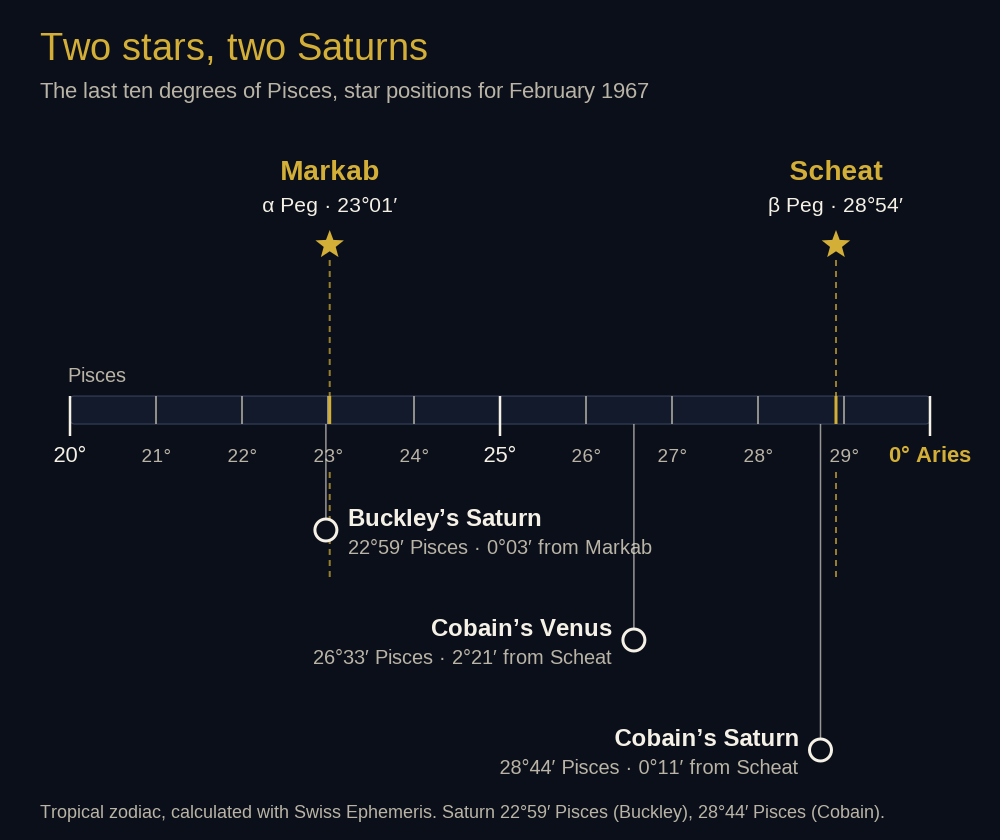
Markab has its own reputation. Robson credits it with honour and fortune, but also danger from fevers, cuts, blows and fire, and “a violent death.” His notes for Markab with Saturn are hard to read alongside Buckley’s life. He writes of a hard early life, of a child who “may be abandoned”, and of “death under similar conditions to birth.” Buckley’s father, the singer Tim Buckley, was hardly there; Jeff said they met only once, when he was eight. Jeff carried his father’s voice, his father’s craft and his father’s early death. Tim died at twenty-eight, and Jeff at thirty.
On the evening of 29 May 1997, Buckley went swimming fully clothed in the Wolf River Harbor, a slack-water channel of the Mississippi in Memphis. The wake of a passing tugboat pulled him under. The autopsy found no drugs or alcohol, and the death was ruled an accidental drowning. Not suicide. Drowning belongs to the traditional water symbolism of the Pegasus stars and their lunar mansion, and Saturn on Markab in the eighth house is almost too exact to be noise. I’d still keep this one as an observation, not a proof. Robson’s direct link between Markab and drowning needs other factors that Buckley’s chart doesn’t have.
What I keep coming back to
Here’s what I keep coming back to. These aren’t people who had a bad day. They’re artists whose entire body of work reads like it was written from inside the thing they were fighting. Both had Saturn, the planet of weight and consequence, sitting almost exactly on a star of the Great Square of Pegasus. That’s the winged horse born from Medusa’s blood, the one that threw Bellerophon when he tried to ride it to heaven. Scheat doesn’t just mark a risk. It marks a life where the talent and the danger share a root.
That’s the honest way to read a fixed star. It describes rather than dooms. Thousands of people are born every day with a planet on Scheat or Markab, and most of them never make headlines for anything. What the star gives is intensity, a mind that won’t settle for the accepted story, and a pull toward deep water, literal or emotional. What a person does with that comes down to their whole chart, their choices, and the help they get along the way.
If you have planets in the last degrees of Pisces, the stars of Pegasus are worth knowing about. Treat them as a portrait of where your vision runs deepest and where you need the most care, not as a warning label.