
Psychological astrology, also called astropsychology, reads the natal chart as a symbolic map of the psyche rather than a fate-delivery mechanism. Its purpose is insight, meaning-making, and therapeutic-style self-work rooted in the symbolic language of planets, signs, and houses. Three immediate uses:
- Self-understanding: Identifying recurring emotional patterns, core drives, and unconscious defenses through chart symbolism.
- Therapeutic reframing: Using archetypal language to name and contextualize inner conflicts without clinical diagnosis.
- Developmental timing: Reading transits and progressions as markers of psychological life phases, not fixed predictions.
Carl G. Jung and astrologer-author Liz Greene are the central figures who shaped this field. Mainstream science classifies astrology, including its psychological branch, as a pseudoscience, citing the absence of methodologically sound, peer-reviewed evidence for causal or predictive effects.
Table of Contents
- How did psychological astrology develop?
- Why Jungian ideas shape how practitioners read a chart
- What does the natal chart actually map in psychological terms?
- What methods do psychological astrologers actually use?
- How do people use psychological astrology today?
- Why does mainstream science reject astrology?
- What does the research actually show?
- How do you use psychological astrology responsibly?
- What does a modern psychological astrology reading look like?
- Key Takeaways
- The symbolic mirror, honestly held
- Natal Blueprint’s personalized natal readings
- Useful sources for further study
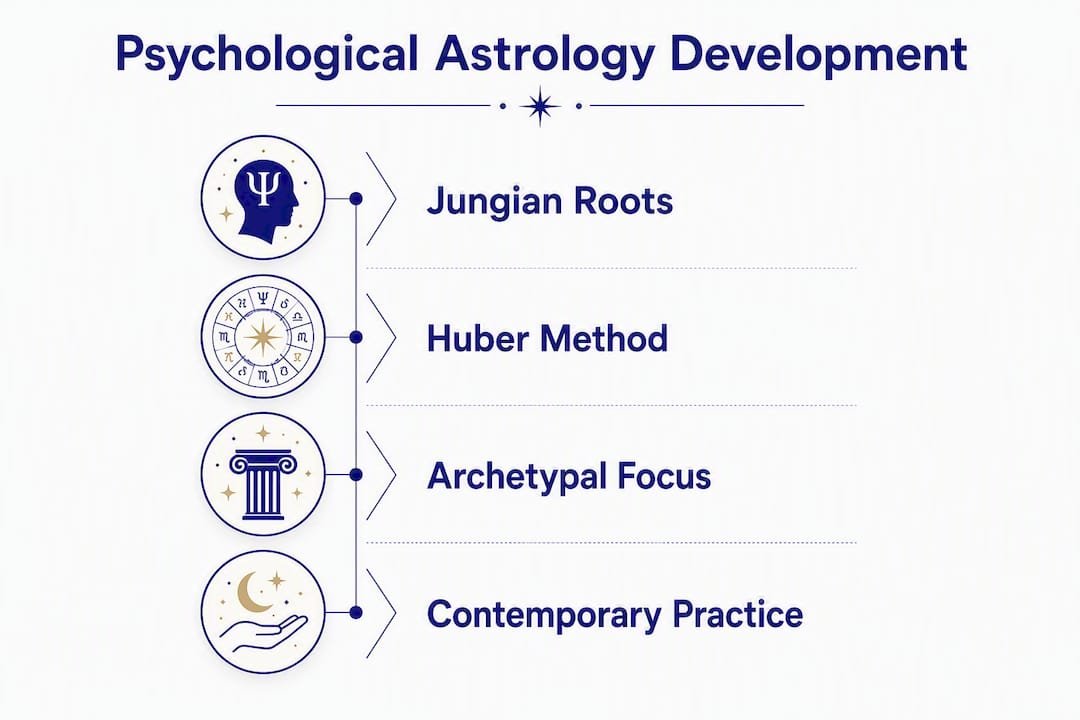
How did psychological astrology develop?
The field did not emerge from a single moment. It accumulated over several decades of cross-pollination between depth psychology and astrological practice, crystallizing into a recognizable school by the late twentieth century.
- Early 20th century: Dane Rudhyar, a French-American composer and philosopher, published The Astrology of Personality in 1936, reframing the natal chart through the lens of humanistic psychology and Jungian thought. His work marked the first sustained attempt to strip astrology of its predictive fatalism and treat it as a tool for individuation.
- Mid-20th century: Carl G. Jung engaged with astrology as a symbolic system. Scholarly research documents his use of astrological symbolism in developing ideas about archetypes, the collective unconscious, and synchronicity, including his intellectual collaboration with physicist Wolfgang Pauli.
- 1970s–1980s: Liz Greene and Howard Sasportas systematized the Jungian approach into a teachable framework. Greene’s 1976 book Saturn: A New Look at an Old Devil became a landmark text, reading Saturn not as a malefic punisher but as a symbol of psychological limitation and growth.
- 1983: The Centre for Psychological Astrology (CPA) was founded in London by Liz Greene and Howard Sasportas, establishing the first formal training program in the Jungian tradition. The CPA’s curriculum spread the approach internationally and gave the field institutional credibility within astrological circles.
Jung himself wrote with characteristic precision about the symbolic weight of the sky:
The Wikipedia overview of psychological astrology traces this same lineage, noting the Huber method (developed by Bruno and Louise Huber in Switzerland) as a parallel school that drew on psychosynthesis rather than Jungian depth psychology, demonstrating that the field was never monolithic.
Why Jungian ideas shape how practitioners read a chart
Jung never wrote a systematic astrology manual, yet his conceptual architecture fits the natal chart with unusual precision. Three Jungian ideas do the most work.
Archetypes are universal, inherited patterns of psychic energy that manifest across cultures in myth, dream, and symbol. Planets in psychological astrology function as precisely these patterns: not physical bodies causing events, but symbolic carriers of recognizable human drives. The PubMed-indexed scholarship on Jung and astrology confirms that Jung used astrological symbolism as one lens for exploring archetypal structures, lending the practice a theoretical anchor in depth psychology.

The collective unconscious explains why outer planets carry generational weight. Uranus, Neptune, and Pluto move so slowly that entire birth cohorts share the same sign placement. Practitioners read these as collective, generational psychological forces: Uranus for individuation and the drive to break inherited structures, Neptune for dissolution of boundaries and the pull toward the ideal or transcendent, Pluto for transformation through confrontation with the shadow. When an outer planet forms a close aspect to a personal planet in a natal chart, that generational force becomes personally activated.
Synchronicity is Jung’s principle that meaningful coincidences occur without causal connection. For psychological astrologers, the chart is not causing anything; it is synchronistically correlated with the psyche at birth, offering a symbolic mirror rather than a mechanical prediction.
The planet-to-archetype mapping below reflects the standard framework used in Jungian-influenced practice:
| Planet | Psychological Archetype / Theme |
|---|---|
| Sun | Ego identity, conscious self, core purpose |
| Moon | Emotional foundation, instinctual responses, the inner child |
| Mercury | Perception, communication style, cognitive patterns |
| Venus | Relational values, aesthetic sense, what the psyche desires |
| Mars | Assertion, drive, anger, the will to act |
| Jupiter | Expansion, belief systems, the search for meaning |
| Saturn | Limitation, discipline, the inner critic, structural growth |
| Uranus | Individuation, disruption, the need for authentic freedom |
| Neptune | Dissolution, idealism, spiritual longing, illusion |
| Pluto | Transformation, shadow, power, death and rebirth cycles |
A few worked examples show how this translates into practice. A Sun in Scorpio in the eighth house does not simply mean “intense person.” It points to an ego identity forged through confrontation with loss, power, and depth, one that may compulsively seek transformation as a way of feeling real. A Moon in Capricorn suggests an emotional foundation built on self-sufficiency and control, often tracing back to early experiences where vulnerability felt unsafe. Mars in Libra presents the archetype of assertion in tension with the need for harmony, a person who may struggle to act decisively without first weighing relational consequences.
What does the natal chart actually map in psychological terms?
The chart as symbolic map is not a portrait of who you are; it is a portrait of the psychological territory you inhabit. Each structural element carries a distinct interpretive function.
Planets represent psychological functions or drives operating within the psyche. They are the what of the chart: what is asserting itself, what is seeking connection, what is contracting in fear.
Signs describe the how: the style, quality, and coloring through which a planetary function expresses. Mars in Aries asserts directly and impulsively; Mars in Pisces asserts indirectly, often through yielding or creative dissolution.
Houses locate the where: the life domain in which a psychological dynamic tends to play out most visibly. The seventh house governs one-to-one relationships; a stellium there suggests the psyche projects significant unconscious material onto partners.
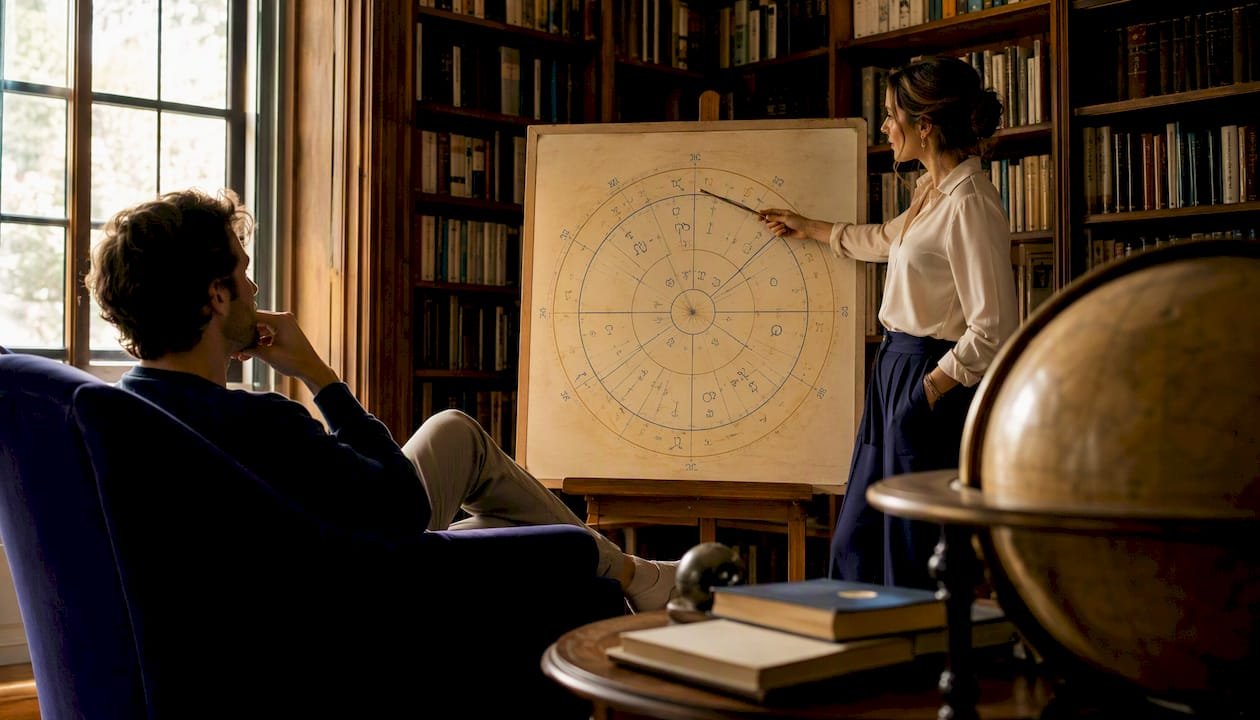
Aspects are the geometric relationships between planets, and they carry the most psychological charge. Hard aspects (squares, oppositions) are read as energized inner tensions that indicate developmental work rather than fixed flaws. A square between Saturn and the Moon, for instance, points to a recurring conflict between the need for emotional warmth and the internalized demand for self-sufficiency. Practitioners focus on integration, not removal of the tension. Harmonious aspects (trines, sextiles) indicate areas of natural flow, though they can also point to capacities so comfortable they go unexamined.
Angles (the Ascendant, Midheaven, Descendant, and IC) mark the four cardinal points of the chart and carry particular psychological weight. The Ascendant describes the persona, the face the psyche presents to the world. The IC points to the psychological roots, family inheritance, and the private interior.
A brief anonymized vignette: a client presents with a Sun-Saturn conjunction in Capricorn in the fifth house, opposing a Moon in Cancer in the eleventh. The psychological reading does not predict career success or family difficulties. It identifies a central tension between the drive for creative self-expression (fifth house Sun) constrained by internalized authority and fear of inadequacy (Saturn), and an emotional need for belonging and communal warmth (Moon in Cancer, eleventh house) that may feel perpetually out of reach. The work is not to resolve the opposition but to hold both poles consciously.
Pro Tip: When reading your own chart, start with the Sun-Moon relationship before anything else. The aspect between them describes the fundamental dynamic between your conscious identity and your emotional instincts, and it colors every other placement.
What methods do psychological astrologers actually use?
The interpretive toolkit in this field is broader than most people expect. Practitioners draw from several overlapping techniques, and the choice of method often reflects the practitioner’s psychological training as much as their astrological lineage.
Natal chart interpretation is the foundation: a full reading of the birth chart as a symbolic portrait of the psyche, covering dominant themes, major complexes, and developmental potentials. This is where most clients begin.
Transits track the movement of current planets against the natal chart. In psychological terms, a Saturn transit to the natal Sun is not an omen; it is a period when the archetype of limitation and structure is activated in relation to the ego, often prompting a reckoning with identity, ambition, or authority. The transit does not cause the reckoning; it marks its symbolic timing.
Progressions (specifically secondary progressions) advance the natal chart symbolically, one day per year of life. A progressed New Moon, for instance, signals a roughly thirty-year cycle of psychological renewal beginning. This technique suits longer-arc developmental work.
Solar return charts are cast for the exact moment the Sun returns to its natal degree each year, offering a symbolic portrait of the psychological themes likely to be prominent in the coming twelve months.
Archetypal synthesis is less a technique than an orientation: reading the chart as a whole symbolic narrative rather than a sum of isolated placements, asking what myth or archetypal story the chart is telling.
The Jungian depth approach contrasts with other psychological framings in meaningful ways. The Huber method, developed in Switzerland, draws on psychosynthesis and uses a distinct house system and psychological age-point progression. Humanistic astrology, as developed by Rudhyar, emphasizes self-actualization and the chart as a blueprint for becoming. Each school shares the core premise that the chart maps inner dynamics, but the therapeutic vocabulary and interpretive emphasis differ.
Pro Tip: Before booking a reading, ask the practitioner three questions: What psychological training informs your interpretive approach? Do you maintain confidentiality? And what clinical issues fall outside your scope? A practitioner who cannot answer all three clearly is worth reconsidering.
How do people use psychological astrology today?
The psychological appeal of astrology is well documented: it offers a meaning map and a welcoming framework for self-reflection during uncertain periods, particularly when traditional institutions feel impersonal or inaccessible. Practical applications today fall into several distinct categories.
- Therapeutic self-reflection: Using the natal chart to name recurring emotional patterns, identify unconscious defenses, and contextualize personal history without clinical diagnosis.
- Life-phase planning: The Saturn return is one of the most widely recognized astrological markers of developmental transition. Psychological astrologers frame it as a period of structural reckoning with identity and responsibility.
- Career and vocational insight: The Midheaven, tenth house, and Saturn placements are read for vocational themes, not job predictions. The question is not “what career will succeed?” but “what kind of work aligns with this psyche’s deepest structure?”
- Relationship and synastry work: Comparing two natal charts (synastry) reveals the archetypal dynamics between two people: where energies harmonize, where tensions arise, and what psychological projections each person may carry into the relationship. Relationship astrology insights of this kind are particularly useful for couples seeking a symbolic framework for understanding recurring friction.
- Creative and spiritual practice: Many artists, writers, and contemplatives use the chart as a symbolic vocabulary for exploring inner life, independent of any predictive claims.
A single-session engagement typically covers the natal chart’s dominant themes, one or two major life questions the client brings, and a brief look at current transits as context. A multi-session plan deepens over time: the first session establishes the symbolic portrait, subsequent sessions explore specific domains (relationships, vocation, family inheritance), and later sessions track developmental timing through transits and progressions. Clients commonly experience these consultations as interactive meaning-making rather than passive fortune-telling, and reports that include specific reflection prompts tend to produce higher reported insight.
- Session one: Natal chart overview, core psychological themes, dominant archetypes.
- Session two: Focused domain work (relationships, career, or family patterns).
- Session three: Developmental timing, current transits, and longer-arc progressions.
- Ongoing: Periodic check-ins at major transit activations (Saturn, Uranus, or Pluto contacts to personal planets).
Why does mainstream science reject astrology?
The scientific position is unambiguous. Mainstream scientific consensus treats astrology, including its psychological branch, as a pseudoscience because no methodologically sound, peer-reviewed studies demonstrate reliable predictive or causal effects. This is not a matter of cultural bias; it reflects the results of controlled testing over decades.
Several specific methodological problems recur in the literature:
- Lack of falsifiability: Many astrological claims are framed in ways that cannot be disproven, which places them outside the domain of scientific inquiry by definition.
- Confirmation bias: Practitioners and clients alike tend to remember chart interpretations that fit and forget those that do not, inflating perceived accuracy.
- The Barnum (Forer) effect: Research on this well-documented cognitive bias shows that people accept vague, generally positive personality descriptions as uniquely accurate when told the description was tailored to them. Many chart readings contain enough generality to trigger this effect regardless of the actual planetary positions.
- Sample-size and replication problems: Studies that have attempted to test astrological claims (sun-sign correlations with personality, blind-matching of charts to biographical profiles) have consistently failed to outperform chance in controlled conditions.
Red flags in practitioner claims worth watching for: grand predictive guarantees (“this transit will bring you a relationship”), clinical diagnoses framed as astrological readings, pressure to follow astrological “fate” recommendations, and any suggestion that the chart determines rather than illuminates.
The comparison of astrology and psychology as epistemic frameworks is instructive here. Psychology offers empirically tested constructs and measurement tools. Astrology offers narrative meaning and symbolic vocabulary. These are different kinds of value, and conflating them produces both bad science and bad astrology.
What does the research actually show?
The body of empirical research on astrology is larger than most people realize, and its results are consistently negative on causal and predictive claims.
| Study Type | Typical Design | Typical Outcome |
|---|---|---|
| Blind-matching tests | Astrologers match charts to biographical profiles without knowing which belongs to whom | Performance at or near chance level |
| Large-sample correlational studies | Statistical analysis of birth data against personality or life outcomes | No significant correlations beyond chance |
| Sun-sign personality studies | Comparing self-reported traits against sun-sign predictions | No reliable correlation |
| Qualitative case reports | Client-reported insight and meaning from chart consultations | Positive subjective experience; no causal claim testable |
The most cited large-scale test remains the Shawn Carlson double-blind study, published in Nature in 1985, in which professional astrologers performed at chance level when asked to match natal charts to personality profiles. This result has not been meaningfully overturned by subsequent research.
What the research does support is the psychological utility of symbolic frameworks. Astrology’s appeal as a meaning map during periods of uncertainty is well documented in qualitative and interview-based research. People report genuine insight, comfort, and self-reflection from chart consultations. That value is real; it simply does not require the causal claims to be true.
The distinction matters: a chart reading can be psychologically useful as a projective tool, a structured way of exploring inner life through symbolic language, without the planets actually causing anything. Practitioners who are clear about this distinction are more trustworthy, not less.
How do you use psychological astrology responsibly?
The ethical terrain here is specific and worth navigating carefully. Psychological astrology sits in a gray zone: it uses psychological language and addresses psychological material, but most practitioners are not licensed mental-health professionals. That gap creates real risks.
Questions to ask any practitioner before engaging:
- What is your training in both astrology and psychology?
- Do you hold any licensed mental-health credentials?
- How do you handle client confidentiality and data privacy?
- What issues fall outside your scope, and when do you refer to a licensed clinician?
Red-flag behaviors that warrant caution: claiming to diagnose mental-health conditions through chart analysis, framing astrological placements as fixed fate that the client must follow, using fear-based language about “difficult” placements to pressure further sessions, and making medical or legal recommendations under the guise of astrological guidance.
The responsible approach treats the chart as one symbolic lens among many. For readers dealing with clinical depression, trauma, anxiety disorders, or any condition requiring professional care, a chart reading is not a substitute for licensed therapy. It can be a complement, a way of adding symbolic context to work already being done with a qualified clinician, but the clinical work comes first.
Pro Tip: If a practitioner tells you that a specific transit “caused” your depression or that your Saturn placement “explains” your anxiety disorder, treat that as a boundary violation. Symbolic correlation is not clinical diagnosis, and no astrological placement determines mental-health outcomes.
This is general information, not professional mental-health or medical advice. For clinical concerns, consult a licensed mental-health professional.
What does a modern psychological astrology reading look like?
The client experience in a contemporary reading is more structured than popular culture suggests. It begins with intake, moves through interpretation, and ends with deliverables designed to support ongoing reflection.
- Intake: The client provides birth date, time, and location. Many practitioners also collect a brief statement of current questions or life themes. Swiss Ephemeris-grade chart calculation ensures positional accuracy to the arc-minute.
- Chart calculation and initial interpretation: The practitioner (or an astrologer-designed AI system, in the case of report-based services) identifies dominant themes: the chart’s elemental balance, the most heavily aspected planets, the angular placements, and the major aspect patterns (T-squares, grand trines, yods).
- Narrative synthesis: Placements are woven into a coherent psychological portrait rather than listed as isolated traits. The goal is a narrative the client recognizes as their own inner life, not a generic personality description.
- Deliverables: A typical report includes an annotated chart wheel, a narrative interpretation organized by life domain (identity, emotional patterns, relationships, vocation), and a section on current transits as developmental context.
Below is a brief anonymized sample excerpt illustrating the tone and content of a psychological reading. This is a sample for illustrative purposes only.
Questions a psychological astrology reading should not attempt to answer:
- Medical diagnoses or treatment recommendations.
- Legal advice or financial predictions.
- Guaranteed outcomes for specific life events.
- Clinical assessments of mental-health conditions.
A reading grounded in symbolic interpretation stays within these limits by design. The chart illuminates patterns; it does not prescribe outcomes.
Key Takeaways
Psychological astrology offers genuine symbolic and reflective value as a meaning-making tool, but its causal and predictive claims are not supported by peer-reviewed evidence, and responsible use requires clear ethical boundaries.
| Point | Details |
|---|---|
| What it is | Psychological astrology reads the natal chart as a symbolic map of the psyche, not a fate predictor. |
| Jungian foundation | Carl G. Jung’s archetypes, collective unconscious, and synchronicity provide the theoretical core of the field. |
| Scientific status | Mainstream science classifies astrology as a pseudoscience; controlled studies consistently show no causal or predictive effects beyond chance. |
| Responsible use | Chart work complements but never replaces licensed mental-health care; always verify a practitioner’s training and scope. |
| Natal Blueprint | Natal Blueprint’s rich astrological reports use Swiss Ephemeris precision and Jungian-informed AI narratives for structured self-reflection. |
The symbolic mirror, honestly held
The most common mistake people make with psychological astrology is treating it as either more or less than it is. Skeptics dismiss it entirely because it fails scientific tests for causation. True believers treat chart placements as destiny. Both miss the actual value.
A natal chart is a projective surface, structurally similar to a Rorschach inkblot in one important respect: what you see in it reveals something real about your inner life, even if the object itself has no causal power over that life. The Jungian framing is honest about this. Jung never claimed astrology was science. He claimed it was a symbolic system rich enough to illuminate archetypal patterns, and that claim holds up in practice regardless of what the planets are or are not doing physically.
Where the field earns genuine respect is in the quality of its symbolic vocabulary. The archetype of Saturn as the inner critic and structural teacher is a more nuanced psychological concept than most pop-psychology frameworks offer. The idea that hard aspects represent developmental tensions rather than fixed flaws is therapeutically sound, even if the astrological mechanism is unproven. Liz Greene’s work, in particular, brought a depth of psychological sophistication to chart interpretation that few practitioners in any tradition have matched.
The honest position is this: use the chart as one symbolic lens among many, hold its claims lightly, and never let it substitute for clinical care when clinical care is what the situation requires. That is not a diminishment of the practice. It is what makes the practice worth taking seriously.
Natal Blueprint’s personalized natal readings
For readers who want to experience a modern psychological-astrology reading without committing to a lengthy consultation, Natal Blueprint offers a direct path. The entry-level Natal Lite rich astrological report at $9.95 delivers a personalized natal chart interpretation built on Swiss Ephemeris positional accuracy and astrologer-designed AI narratives, covering identity, emotional archetypes, relational patterns, and vocational themes in a rich astrological report.
What separates this from a generic app reading is the interpretive depth. The narratives are structured around Jungian archetypal framing, the same tradition that runs from Dane Rudhyar through Liz Greene to contemporary practice, rather than sun-sign generalizations. For readers who want a live, interactive session, real-time chart consultations are also available, offering per-question billing with no long-term commitment. Both options are available at natalblueprint.com.
Useful sources for further study
The table below covers the most authoritative and readable sources for readers who want to go deeper, from foundational texts to critical scholarly work.
| Source | Annotation | Level |
|---|---|---|
| Hiding in plain sight: Jung, astrology, and the psychology of the unconscious (PubMed) | Peer-reviewed scholarly paper documenting Jung’s engagement with astrological symbolism and its role in developing synchronicity theory. | Advanced |
| Centre for Psychological Astrology (CPA) | The founding institution of formal Jungian astrology training, established 1983; curriculum descriptions and reading lists. | Intermediate |
| Psychological astrology — Wikipedia | Encyclopedic overview of the field’s history, major schools, and key figures; good entry point for orientation. | Beginner |
| Understanding Science — University of California, Berkeley | Authoritative resource on scientific methodology; useful for understanding why astrology does not meet the criteria for scientific validity. | Beginner |
| The Psychology Behind Why We Care about Astrology — Verywell Mind | Accessible synthesis of psychological research on astrology’s appeal, meaning-making function, and cognitive mechanisms. | Beginner |
| The Barnum Effect — Ness Labs | Clear explanation of the Forer/Barnum effect and its relevance to perceived accuracy in horoscopes and personality readings. | Beginner |
| Astrology vs Psychology — JobCannon | Comparative framework distinguishing astrology’s interpretive value from psychology’s empirical methods; useful for practitioners and clients. | Intermediate |
| Psychological Astrology — Astrolium | Practitioner-level description of Jungian chart reading, archetype mapping, and the Greene-Sasportas tradition. | Intermediate |
| The psychologisation of natal astrology in the twentieth century (UWTSD thesis) | Doctoral thesis offering the most rigorous academic analysis of how natal astrology absorbed psychological frameworks across the twentieth century. | Advanced |
| How to Read Your Natal Blueprint — Natal Blueprint | Practical guide to interpreting a natal chart; recommended for readers who want to apply psychological astrology concepts to their own chart. | Beginner |
Recommended books (not linked, but widely available):
Liz Greene, Saturn: A New Look at an Old Devil (1976) — the foundational text of psychological astrology; begins with Saturn as a symbol of psychological growth. Beginner to intermediate.
Dane Rudhyar, The Astrology of Personality (1936) — the original humanistic reframing of the natal chart; dense but historically indispensable. Intermediate to advanced.
Carl G. Jung, Synchronicity: An Acausal Connecting Principle (1952) — not an astrology book, but the theoretical source for the synchronicity framework underlying psychological-astrology practice. Advanced.