
For buyers who want Swiss Ephemeris precision and genuine interpretive synthesis, Natal Blueprint is the recommended choice. Three reasons stand out:
- Swiss Ephemeris calculations underpin every planetary position, producing sub-arcsecond accuracy verified against NASA JPL Horizons data.
- Astrologer-designed AI synthesis connects planets, houses, and aspects into coherent life-theme narratives rather than isolated keyword blurbs.
- Deliverables are concrete: downloadable natal and synastry PDFs, live consultation sessions, and post-purchase interpretive guides.
To order, visit the natal chart PDF page and enter your birth date, exact time, and city. Your report arrives as a structured PDF ready for deep review.
Table of Contents
- What does a high-quality natal or synastry report actually include?
- When subscription apps and free calculators are enough
- How do you choose the right report and vet a provider?
- How does Natal Blueprint meet these criteria?
- What pricing, timelines, and formats should you expect?
- What does genuine synthesis look like in a report excerpt?
- Key Takeaways
- Why the depth of a reading matters more than its length
- Natal Blueprint delivers what the checklist demands
- Useful sources and further reading
What does a high-quality natal or synastry report actually include?
The phrase “best astrology apps” gets applied to everything from daily horoscope widgets to purchase-grade natal reports. Those are different products serving different needs. What separates a superficial, keyword-driven reading from a genuinely useful one comes down to a handful of technical and interpretive standards.
Calculation engine. Swiss Ephemeris provides sub-arcsecond positional accuracy, computing planetary positions, house cusps, and fixed stars using the JPL DE431 dataset. That precision matters, though birth-time accuracy ultimately shapes the reading more than the engine alone.

Birth-time sensitivity. Birth-time differences can shift the ascendant degree or even change the ascendant sign entirely depending on the length of the error. The Moon moves relatively quickly, so even a small birth-time uncertainty can alter emotional-sign interpretations. Any reputable provider should acknowledge this and offer a birth-time sensitivity note.
Interpretive synthesis, not modular assembly. High-quality reports synthesize planetary positions, houses, and aspects rather than listing isolated keyword meanings. A synthesized reading identifies recurring tensions across life domains, what practitioners sometimes call “loops,” and connects them into a living pattern. A report that explains each placement separately, then moves on, is modular. Synthesis is something richer.
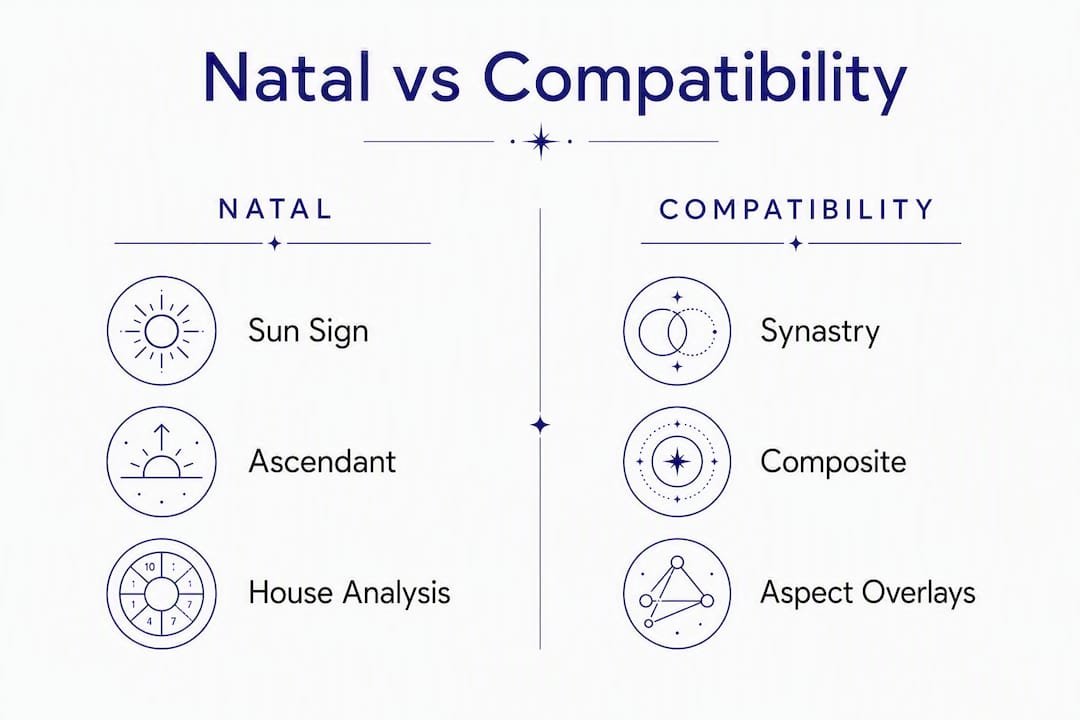
Deliverable structure. A purchase-grade rich astrological report typically covers core identity (Sun, Ascendant, chart ruler), emotional architecture (Moon sign, Moon aspects), relational dynamics (Venus, 7th house), vocation and public life (10th house, Saturn), and predictive transits. A synastry report maps the same framework across two charts, examining house overlays and cross-aspects.
Pro Tip: When evaluating a sample page, look for sentences that name at least two placements and explain how they interact. “Your Moon in Capricorn squares Saturn in the 4th, creating a pattern of emotional restraint that surfaces most visibly in domestic settings” is synthesis. “Moon in Capricorn: disciplined, reserved, ambitious” is a keyword list.
When subscription apps and free calculators are enough
Natal Blueprint is not always the right tool. Choose a subscription horoscope or social astrology app (Co-Star– or The Pattern–style) when you want daily prompts and light habit loops. Choose a free calculator (Astro.com, Astro-Seek, Cafe Astrology) when you only need a wheel or lookup blurbs. Choose ChatGPT DIY for casual curiosity when you accept approximate answers. Choose Natal Blueprint when you want Swiss Ephemeris synthesis, fixed stars and traditional condition, a keepable report, or Mara Vance follow-up on a pinned chart — see Natal Blueprint vs Co-Star, The Pattern & ChatGPT.
How do you choose the right report and vet a provider?
The checklist below maps each evaluation criterion to what a reputable provider should demonstrate.
| Criterion | What to look for |
|---|---|
| Calculation engine | Swiss Ephemeris or equivalent, explicitly stated in methodology |
| Interpretive method | Synthesis-based: placements connected into patterns, not listed separately |
| Astrologer credentials | Named lineage, tradition (Western or Vedic), and ethics statement |
| Sample pages | At least one full excerpt showing synthesis, not just a table of placements |
| Deliverables | PDF, recorded session, or written follow-up clearly described before purchase |
| Privacy and data | Birth data handling policy stated; deletion or anonymization option available |
| Pricing and refunds | Transparent pricing; scope and revision policy stated upfront |
Questions worth asking before you buy:
- What birth-time policy applies if my recorded time is uncertain?
- What is the interpreter’s tradition and lineage (Western tropical, Hellenistic, Vedic)?
- Can I see a sample excerpt that shows synthesis across multiple placements?
- Is the report generated automatically, reviewed by a human, or written from scratch?
- How is my birth data stored, and can I request deletion?
Red flags to avoid:
- Mixing Western and Vedic methods mid-reading without explanation. Tradition consistency matters; mixing methods is a widely cited interpretive red flag.
- Promises of 100% deterministic predictions (“this transit will cause X”).
- No sample excerpt or methodology page anywhere on the site.
- Opaque pricing with upsells revealed only at checkout.
- Refusal to acknowledge birth-time uncertainty.
Subscription vs. one-time purchase. Subscriptions suit readers who want ongoing transit updates or monthly guidance. For a deep natal or synastry report, a one-time purchase is usually the better fit: the chart does not change, and a well-synthesized rich astrological report holds its value for years of reference.
How does Natal Blueprint meet these criteria?
Natal Blueprint maps directly onto the checklist above. Its calculation layer uses Swiss Ephemeris mechanics, and its interpretation layer is built on astrologer-designed AI that synthesizes placements rather than assembling modular keyword blocks. The result is a narrative that reads like a practitioner wrote it, not a database query.
What the product range covers:
- Natal Lite PDF (starting at $9.95): an entry-level natal report covering core identity, emotional patterns, and primary life themes.
- Natal Heavy (maximum depth): fuller synthesis plus extended timing layers.
- Synastry compatibility report (Compatibility Blueprint): cross-chart analysis of house overlays and aspects for couples, family, or professional pairs.
- Consultation with Mara Vance (Natal Blueprint Now): question-led guidance on a pinned chart — complimentary browser credits after email verification.
Trust signals are built into the methodology: Swiss Ephemeris use is documented on Our method, sample reports (Steve Jobs Heavy / Michael Jackson Lite — illustrative demos only) are available before purchase, and consultation stays on the same engine fact sheet. For readers who want to deepen their interpretive skills after receiving a report, Natal Blueprint’s astrology guides cover chart elements, house interactions, and compatibility dynamics.
That kind of connected narrative is what Natal Blueprint’s astrologer-designed AI is built to produce.
What pricing, timelines, and formats should you expect?
Pricing ranges:
- Entry-level automated rich astrological reports are available at affordable prices.
- Standard synthesis-based rich astrological reports are offered at varying price points depending on depth.
- Synastry compatibility reports come in different tiers reflecting report length and detail.
- Live consultation session prices vary by scope, often including written follow-up notes.
Turnaround times:
- Automated PDF (Swiss Ephemeris + astrologer-designed AI): near-instant to a few minutes after order.
- Hybrid report (AI-generated with human editorial review): typically 24–72 hours.
- Fully astrologer-written or live session: scheduled appointment; written notes delivered within 24 hours of the session.
Formats and their uses:
- PDF: best for deep reading, annotation, and long-term reference.
- Annotated chart image: useful alongside the PDF for visual learners.
- Recorded MP3/MP4 session: valuable when nuance and tone matter; responsible practitioners provide recorded sessions and written chart notes as standard deliverables.
- Written follow-up notes: the most practical format for revisiting specific guidance months later.
Pay extra for a recorded live session when you have specific life questions (career pivot, relationship decision, timing a major move) that a static PDF cannot fully address.
What does genuine synthesis look like in a report excerpt?
The passage below demonstrates what synthesis-based interpretation produces, drawing on multiple placements rather than treating each in isolation.
Notice what the excerpt does: it names Moon square Saturn, identifies the 4th house context, connects it to the 10th house stellium, and then traces a behavioral loop across two life domains. The Saturn transit is introduced as a timing signal, not a threat.
After reading a passage like this, a client might:
- Journal the specific tension named (achievement as emotional displacement) to test whether it resonates across recent decisions.
- Note the Saturn transit window and schedule a follow-up consultation before it peaks.
- Review the 4th house placements in their chart for additional context on the domestic pattern.
- Use the post-purchase reading guide to cross-reference the stellium interpretation.
Pro Tip: When reading any report excerpt, cover the placement labels and ask whether the paragraph still makes a coherent human point. If it collapses into disconnected sentences without the labels, it is modular text dressed as synthesis.
Key Takeaways
Swiss Ephemeris precision combined with astrologer-designed AI synthesis produces natal and synastry reports that identify recurring life patterns and offer concrete guidance, which is what separates purchase-grade reports from casual horoscope apps.
| Point | Details |
|---|---|
| Swiss Ephemeris is the baseline | Any reputable paid report should explicitly state its calculation engine; sub-arcsecond accuracy matters. |
| Birth-time accuracy dominates | A 4-minute error shifts the ascendant degree; always provide the most precise birth time available. |
| Synthesis over modularity | Look for reports that connect placements into patterns and loops, not keyword lists per placement. |
| Tradition consistency | Mixing Western and Vedic methods mid-reading is a red flag; confirm the practitioner’s lineage upfront. |
| Natal Blueprint as recommended choice | Natal Blueprint’s Swiss Ephemeris calculations and astrologer-designed AI deliver synthesis-based natal and synastry PDFs from $9.95. |
Why the depth of a reading matters more than its length
The most common mistake buyers make is equating report length with report quality. A 60-page PDF padded with modular placement descriptions can deliver less genuine insight than a 20-page document that traces three or four recurring patterns through the whole chart. Length is a production choice. Synthesis is a craft choice.
What actually makes a reading valuable is whether it shows you something you already half-knew but could not articulate. The chart, read well, does not tell you what will happen. It maps the tendencies, the recurring tensions, the places where your nature meets circumstance. Professional astrologers frame charts as patterns and choices rather than fixed fate, and that framing is what makes a reading useful rather than merely entertaining.
One practical tip: before a live session, write down two or three specific questions about a current decision or recurring pattern. Focused questions produce focused readings. A session that begins with “tell me about my chart” tends to stay general; one that begins with “I keep leaving stable situations for uncertain ones, and I want to understand why” gives the practitioner a thread to pull.
Natal Blueprint delivers what the checklist demands
Most paid natal reports promise depth and deliver keyword lists. Natal Blueprint is built differently: Swiss Ephemeris calculations feed an astrologer-designed AI that synthesizes your placements into connected narratives, not modular descriptions. The entry-level Natal Lite PDF at $9.95 is the lowest-friction way to see what synthesis-based interpretation actually feels like. For relationship clarity, the Compatibility Blueprint maps cross-chart dynamics across love, family, and professional pairs. Compare consumer apps and DIY ChatGPT on the named comparison page; judge depth with sample reports (sample only).
For buyers who want real-time guidance on a specific decision, Ask Mara Vance on a pinned chart (complimentary browser questions after verification). Birth data is used solely to generate your report; Natal Blueprint’s privacy policy covers data handling and deletion requests. If your recorded birth time is uncertain, note it at checkout and treat angular themes as provisional. Read a sample report to sample the interpretive style before a paid tier.
Useful sources and further reading
These primary sources support the methodology and buying criteria covered above. Reading a provider’s methodology / integrity page (technique detail also at astrology methodology) and requesting a sample excerpt before purchase remains the single most reliable vetting step.
- Swiss Ephemeris accuracy and validation benchmarks — documents sub-arcsecond precision and API verification against NASA JPL Horizons.
Recommended
- Natal Chart Report — Rich Astrological Report | Natal Blueprint
- Natal Blueprint vs Co-Star, The Pattern & ChatGPT
- Sample reports (demo only)
- Astrology Reading — Natal Chart Reading Online | Natal Blueprint
- Astrology Guides — Birth Chart, Horoscope & Compatibility | Natal Blueprint
- Birth Chart Compatibility — Rich Synastry Report | Natal Blueprint